Are Peptides Legal in Canada? What to Know in 2026
Are peptides legal in Canada? Learn how Health Canada regulates peptides as drugs, what research use labels mean, and how WADA rules…
Research guide
September 16, 2026
The difference in CJC-1295 DAC vs no DAC is one added chemical group. Both forms share the same modified 29-amino-acid analogue of growth hormone-releasing hormone (GHRH). CJC-1295 with DAC also carries a drug affinity complex: an extra lysine with a reactive group that bonds to albumin in the blood, which gave it an estimated half-life of 5.8 to 8.1 days in a 2006 study of healthy adults. The no-DAC form, often sold as modified GRF(1-29), has not been characterized in controlled human studies.
This guide explains each form, how albumin binding works, and where ipamorelin, which acts on a different receptor, fits in.
CJC-1295 is a synthetic analogue of GHRH built on GHRH(1-29), the 29-amino-acid fragment that also forms sermorelin. Its sequence carries four substitutions: D-alanine at position 2, glutamine at 8, alanine at 15 and leucine at 27.
Those positions match known weak points of the natural sequence. A 1994 study of GRF analogues described native GHRH being cut by the enzyme DPP-4 between positions 2 and 3, rearranging chemically at asparagine 8 and oxidizing at methionine 27, and noted that alanine at position 15 had been shown to enhance receptor binding.
The name is used loosely. In the 2005 paper that introduced it, CJC-1295 meant the substituted peptide plus a lysine carrying a maleimide group, the part known as the drug affinity complex (DAC). The version without it is commonly sold as modified GRF(1-29), or “CJC-1295 no DAC”, which is the form in our CJC-1295 No DAC / Ipamorelin research blend.
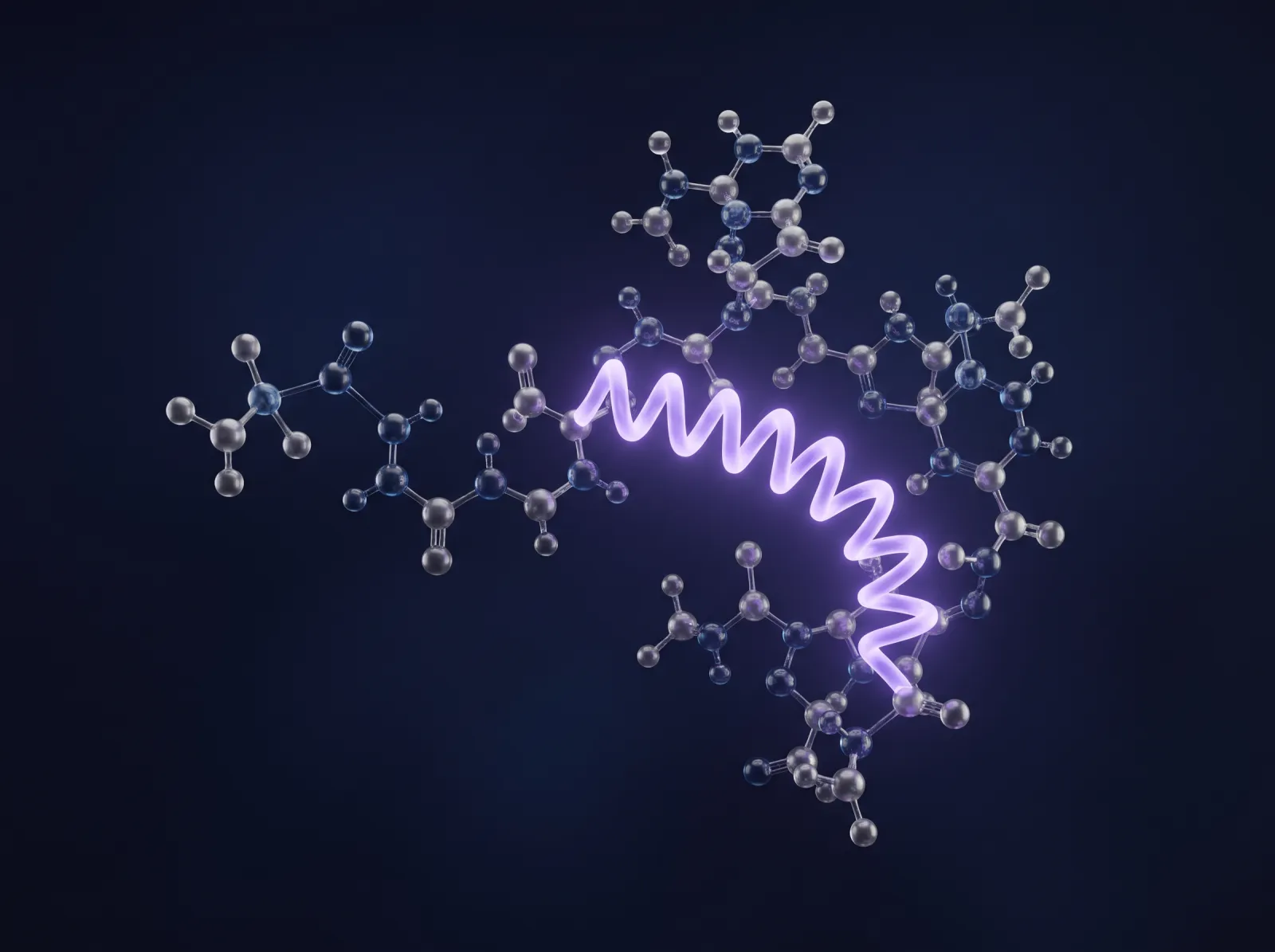
In CJC-1295 with DAC, an extra lysine at the C-terminal end carries a 3-maleimidopropionamide group. In circulation, that group forms a covalent bond with the free thiol on cysteine 34 of serum albumin, the main protein in blood plasma. In the 2005 study, albumin conjugates resisted DPP-4 in laboratory tests, and in rats CJC-1295 was still present in plasma beyond 72 hours.
The main human data come from Teichman and colleagues (2006): two randomized, placebo-controlled, double-blind trials in healthy adults aged 21 to 61. After a single administration, mean growth hormone rose 2- to 10-fold for 6 days or more and IGF-I rose 1.5- to 3-fold for 9 to 11 days, with an estimated half-life of 5.8 to 8.1 days. A follow-up study in healthy men found growth hormone was still released in pulses, with markedly higher trough levels between them.
Comparable human data are lacking for the no-DAC form. A 2026 review in Frontiers in Endocrinology found no controlled human studies of it, so claims about its behaviour are extrapolated from related peptides such as sermorelin.
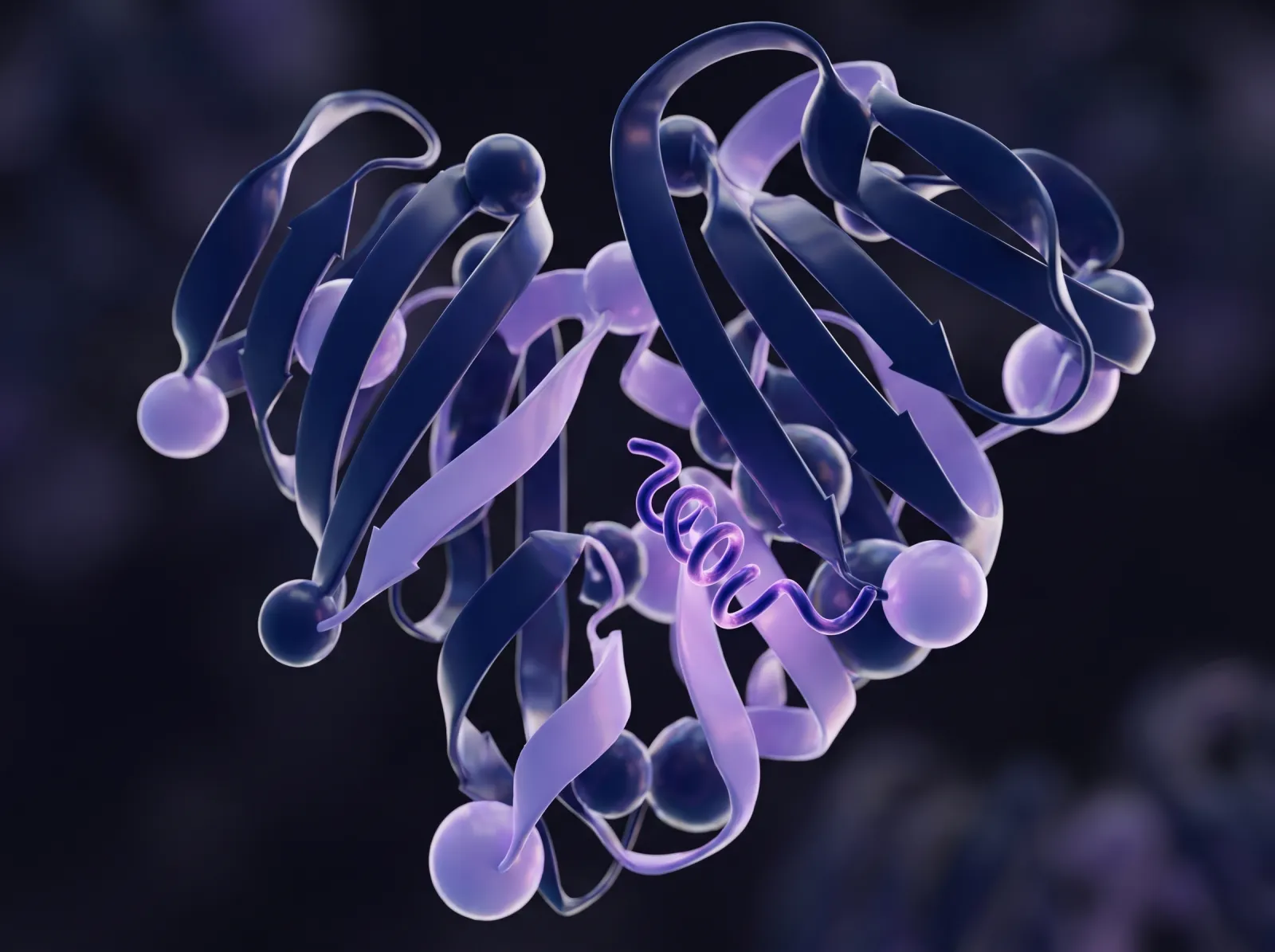
Ipamorelin is a synthetic pentapeptide (Aib-His-D-2-Nal-D-Phe-Lys-NH2) developed by researchers at Novo Nordisk. It does not act on the GHRH receptor. Instead, it works through the same receptor as the older peptide GHRP-6: the growth hormone secretagogue receptor (GHS-R1a), which is also the receptor for the hormone ghrelin.
What set it apart in the 1998 study that introduced it was selectivity. In rat pituitary cells, anaesthetized rats and conscious swine, ipamorelin released growth hormone with potency and efficacy similar to GHRP-6. In swine, GHRP-6 and GHRP-2 also raised ACTH and cortisol, while ipamorelin did not raise them beyond levels seen with GHRH, even at more than 200 times the amount needed for a half-maximal growth hormone response.
CJC-1295 vs ipamorelin is therefore not a like-for-like choice: one is a GHRH analogue, the other a ghrelin receptor agonist. Because they act on separate receptors that both regulate pituitary growth hormone release, they are sometimes supplied together as a research blend.
| Feature | CJC-1295 with DAC | CJC-1295 no DAC (modified GRF 1-29) |
|---|---|---|
| Core peptide | GHRH(1-29) with D-Ala2, Gln8, Ala15 and Leu27 | Same |
| Added group | C-terminal lysine with a maleimidopropionamide group | None |
| Albumin binding | Covalent bond to cysteine 34 of albumin | None |
| Human half-life | Estimated 5.8 to 8.1 days (2006 trials) | Not reported in peer-reviewed human studies |
| Human evidence | Randomized, placebo-controlled trials and a pulsatility study in healthy adults | No controlled human studies identified (2026 review) |
| Approved medicine | No, in Canada or the United States | No, in Canada or the United States |
| Sport | Prohibited by WADA (S2.2.4) | Prohibited by WADA as a GHRH analogue (S2.2.4) |
| At Flux | Not stocked | In the CJC-1295 No DAC / Ipamorelin blend |
“CJC-1295 ipamorelin” usually refers to a blend of CJC-1295 without DAC and ipamorelin in one product. Flux lists its version as a 10 mg blend of 5 mg CJC-1295 No DAC and 5 mg ipamorelin, supplied as lyophilized powder for laboratory research.
The research rationale is receptor pairing: a GHRH analogue and a ghrelin receptor agonist reach pituitary growth hormone release through two different receptors. Evidence on the combination is thin, because the no-DAC component itself lacks controlled human studies. Flux publishes no dosing, “pulsing” or usage protocols, and the blend is not for human use.
Each batch is assayed by HPLC against a minimum 99.0% purity specification. Our guides to peptide purity testing and how to store peptides explain what that specification means and how lyophilized material is kept.
All three are GHRH analogues that act on the same pituitary receptor. Sermorelin is the natural GHRH(1-29) sequence, and tesamorelin is the full 44-amino-acid hormone with a stabilizing group at its N-terminus; both are cleared within minutes. CJC-1295 with DAC is the long-acting outlier because of albumin binding. Our sermorelin 5mg research peptide and tesamorelin research peptide are compared in detail in Tesamorelin vs Sermorelin: Key Differences Explained.
No. Both are built on the 29-amino-acid GHRH(1-29) sequence, but CJC-1295 no DAC carries four substitutions, at positions 2, 8, 15 and 27, where the natural sequence is prone to enzymatic cleavage, chemical rearrangement or oxidation, or where receptor binding can be improved. Sermorelin keeps the natural sequence and was once an FDA-approved medicine, Geref.
No. The World Anti-Doping Agency’s 2026 Prohibited List names CJC-1295 among growth hormone-releasing hormone analogues in section S2.2.4, and lists ipamorelin in the same section as a growth hormone secretagogue. Substances in section S2 are prohibited at all times, in and out of competition. Athletes should check the current list and their sport’s rules.
Short GHRH analogues are vulnerable to enzymes such as DPP-4 and clear quickly. Bonding to albumin, a large and abundant plasma protein, is a strategy for extending plasma half-life: in the 2005 study, albumin conjugates of CJC-1295 resisted DPP-4 in laboratory tests, and in healthy adults the DAC form had an estimated half-life of 5.8 to 8.1 days.
Flux Peptides supplies the CJC-1295 No DAC / Ipamorelin blend strictly for laboratory research. It is not approved by Health Canada for human or veterinary use, and nothing in this article is medical advice.