Are Peptides Legal in Canada? What to Know in 2026
Are peptides legal in Canada? Learn how Health Canada regulates peptides as drugs, what research use labels mean, and how WADA rules…
Research guide
September 16, 2026
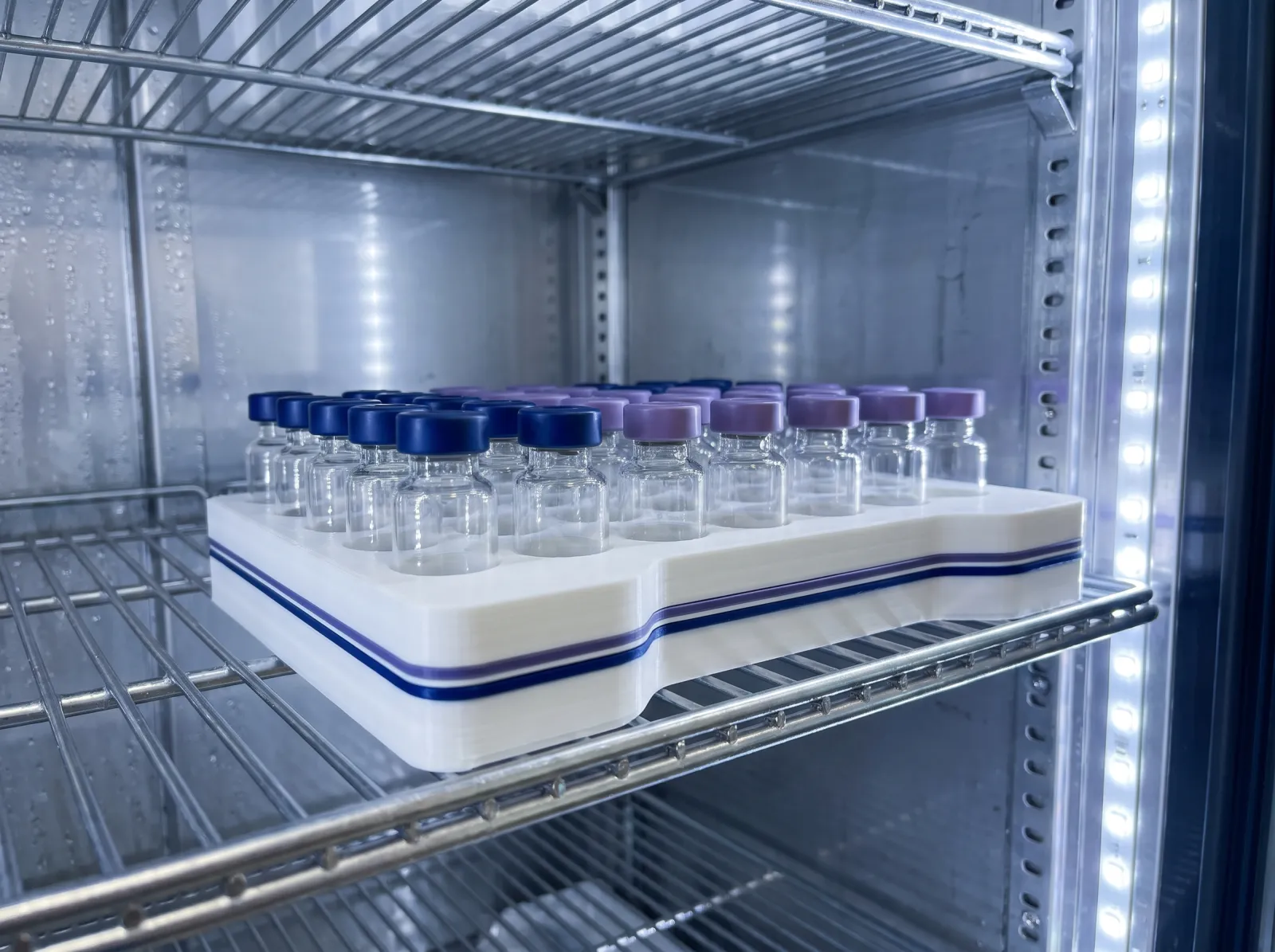
Knowing how to store peptides comes down to one distinction. Lyophilized (freeze-dried) peptides should be kept sealed, dry and away from light at minus 20 degrees Celsius or colder, where most stay stable for years. Reconstituted peptides are far less stable, so keep them refrigerated for short-term work or freeze them as single-use aliquots.
This guide explains the reasoning behind those rules, using handling guidelines published by peptide manufacturers such as Bachem and GenScript. It covers peptide storage temperature for both forms, the conditions that degrade peptides fastest, and how Flux stores its own research stock.
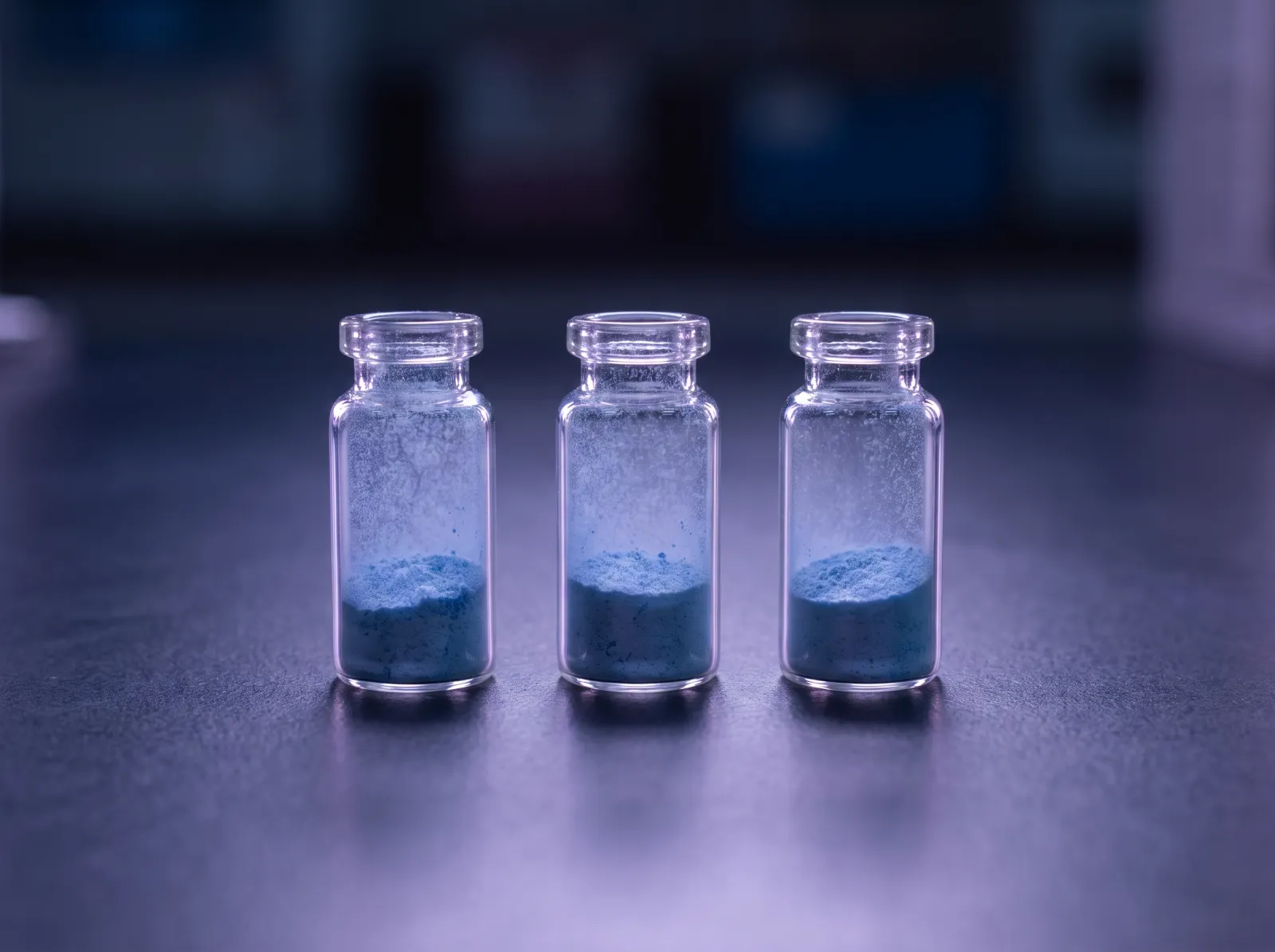
Lyophilization removes water from a frozen peptide solution under vacuum, leaving a dry cake of powder in the vial. Taking the water out matters because many degradation reactions depend on it, including hydrolysis of peptide bonds and deamidation of asparagine and glutamine. A 2023 review in Pharmaceutics notes that peptides are often unstable in aqueous solutions, and Bachem recommends keeping peptides as the dry lyophilizate for longer storage.
Manufacturer guidelines agree on four conditions for lyophilized peptide storage:
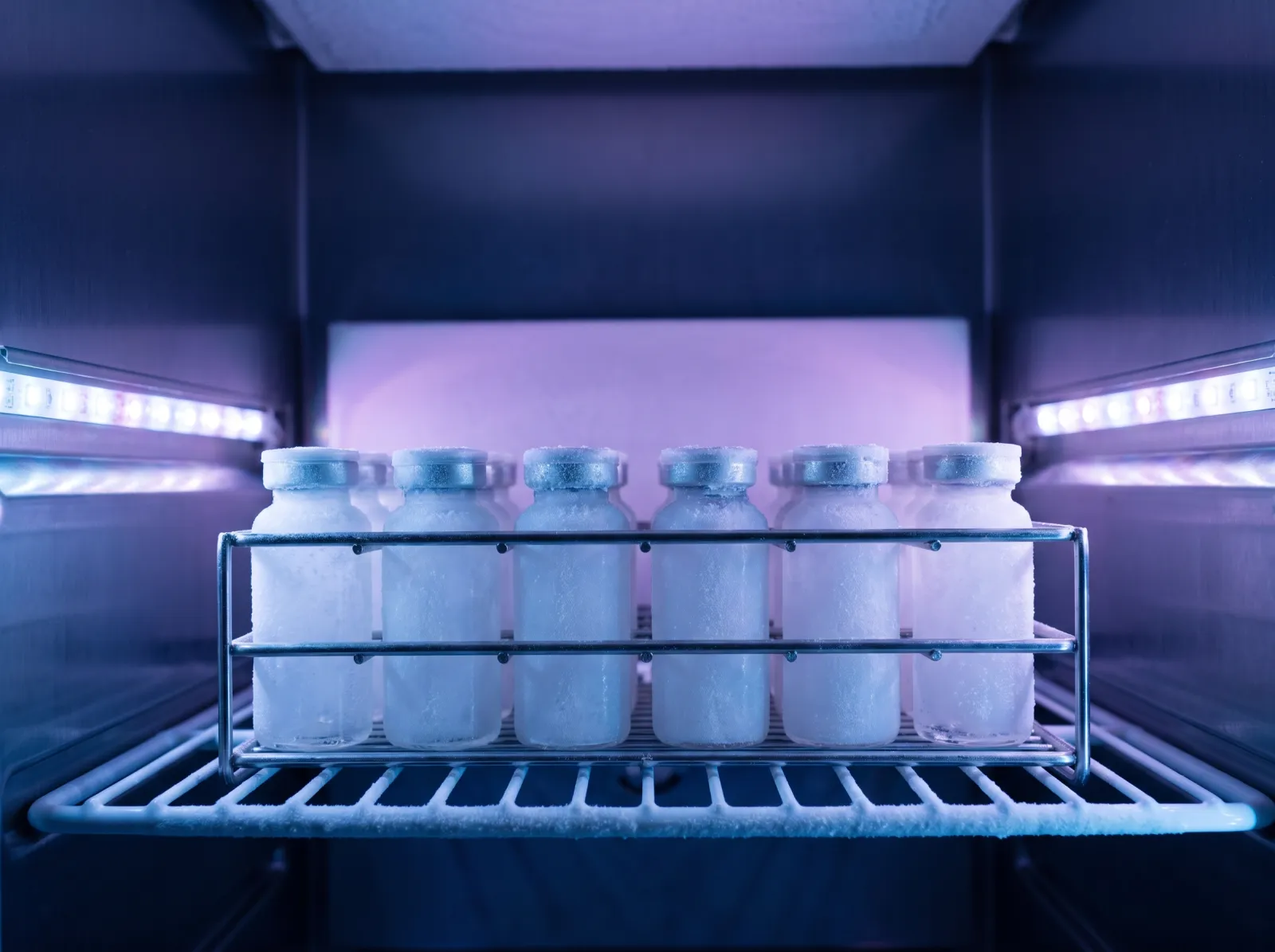
Under these conditions, GenScript reports that most lyophilized peptides remain stable for several years. Flux holds its lyophilized stock sealed at minus 20 degrees Celsius for the same reason.
Once a peptide is dissolved, it degrades far faster. Bachem advises against storing peptides in solution, even a sterile, oxygen-free one, because they may slowly break down, and GenScript adds that peptide solutions are susceptible to bacterial degradation. For the dissolving step itself, see our lab guide to reconstituting peptides.
For short-term work, keep reconstituted solutions refrigerated at 2 to 8 degrees Celsius. Flux’s listings for BPC-157 and GHK-Cu, for example, specify 4 degrees Celsius and a working window of 14 to 21 days. If a solution was prepared with bacteriostatic water, the opened diluent vial has its own time limit, explained in How Long Does Bacteriostatic Water Last?
For longer storage, manufacturers recommend splitting the solution into single-use aliquots and freezing them. When keeping a peptide in solution cannot be avoided, GenScript suggests a buffer at pH 5 to 6 and aliquots stored at minus 20 degrees Celsius. Each aliquot is then thawed once, instead of the whole batch going through repeated freeze-thaw cycles.
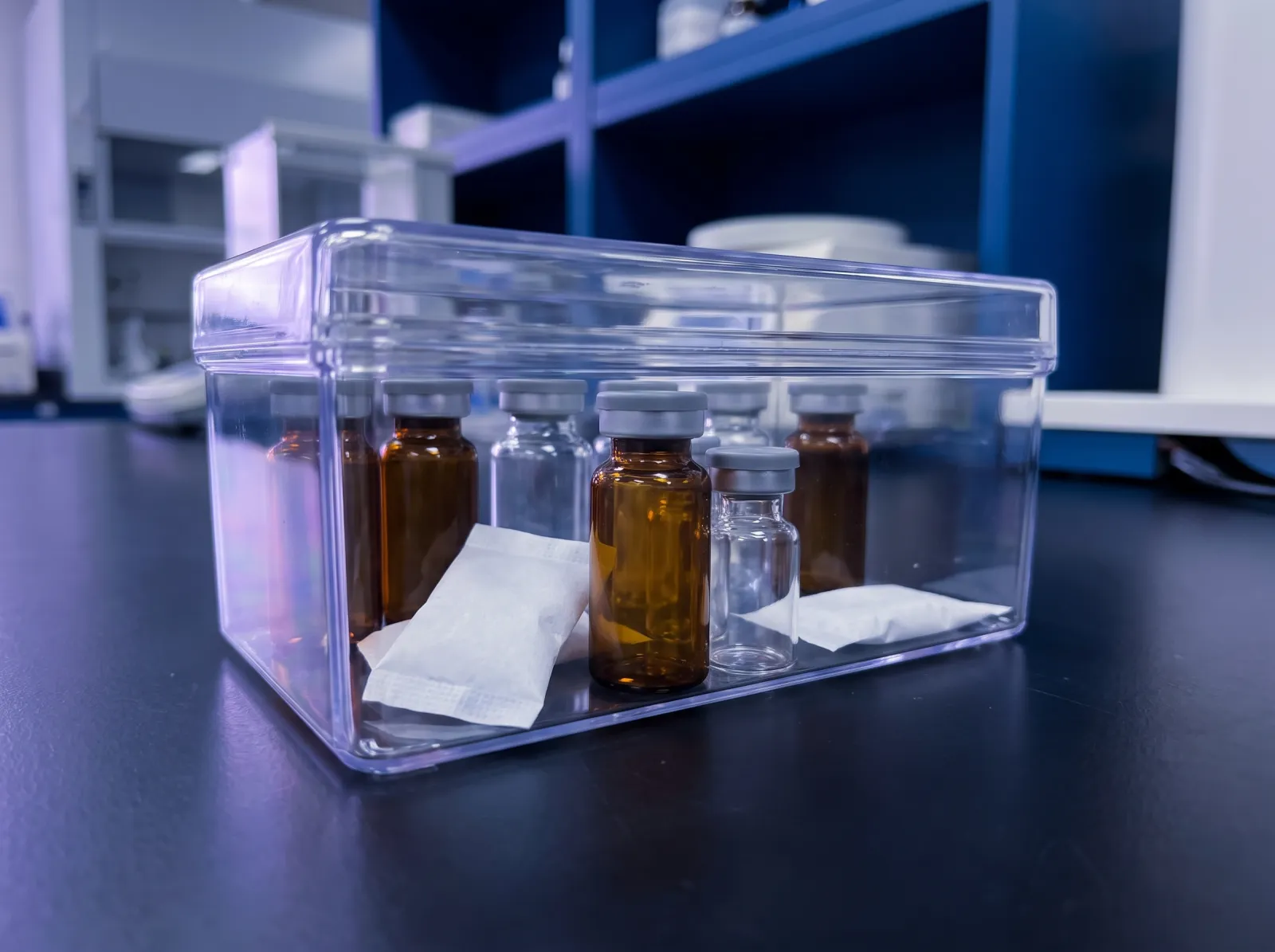
Moisture. Peptides tend to be hygroscopic. Bachem notes that absorbed moisture reduces the overall peptide content and may decrease stability, and GenScript flags peptides containing aspartic acid, glutamic acid, lysine, arginine or histidine as especially prone. Let a cold vial reach room temperature, ideally in a desiccator, before opening it, then reseal it quickly. A sealed container with desiccant packets adds a second barrier.
Light. Light-induced oxidation usually affects peptides with aromatic residues such as tryptophan and tyrosine, so store vials in the dark or in amber glass. Flux’s GHK-Cu listing, for instance, advises protecting the blue copper complex from excessive light and heat.
Oxidation and freeze-thaw. Cysteine, methionine and tryptophan oxidize readily, and GenScript recommends storing peptides that contain them under anaerobic conditions. Temperature swings cause harm too: freezing can induce aggregation, and every freeze-thaw cycle adds stress. AAPPTEC advises against keeping frozen peptide solutions in a frost-free freezer, because those units warm periodically to defrost.
The table summarizes typical conditions from manufacturer guidelines. Sequence matters, so always check the storage section of the documentation for the specific peptide.
| Factor | Lyophilized peptides | Reconstituted peptides |
|---|---|---|
| Long-term storage | Minus 20 degrees Celsius or colder, sealed and dry | Not recommended; if unavoidable, frozen single-use aliquots |
| Short-term storage | Room temperature during shipping, or about 4 degrees Celsius for short-term use | Refrigerated at 2 to 8 degrees Celsius |
| Typical stability | Months to several years, depending on sequence | Days to a few weeks, depending on sequence, solvent and pH |
| Main risks | Moisture uptake, light, oxidation | Chemical breakdown, bacterial growth, freeze-thaw damage |
| Key habit | Warm to room temperature before opening | Aliquot so each portion is thawed only once |
Good storage protects good material, but it cannot rescue material that was out of specification to begin with. Every Flux batch is assayed by HPLC against a minimum 99.0% purity specification, and each order carries a batch identifier so the analysis can be traced to the exact material. Our guide to peptide purity testing explains how to read those results, and the full range of research peptides is in the Flux shop.
Not for short periods. Bachem notes that even peptides with limited shelf lives can be shipped at room temperature and kept in a refrigerator at 4 degrees Celsius for short-term use. For anything longer, manufacturers recommend freezing at minus 20 degrees Celsius or colder in a sealed, dry vial. Refrigeration is a stopgap for lyophilized material, not a long-term plan.
Stored sealed, dry and dark at minus 20 degrees Celsius, most lyophilized peptides remain stable for several years, according to GenScript. AAPPTEC gives a wider range of three months to five years. Sequence explains much of the difference: Bachem notes that peptides containing asparagine, glutamine, methionine, cysteine or tryptophan have limited shelf lives. Check the storage period stated for the specific product.
As a lyophilized powder, BPC-157 should be frozen rather than refrigerated for long-term storage, and Flux’s listing specifies minus 20 degrees Celsius. Once reconstituted, the solution should be kept refrigerated; the same listing specifies 4 degrees Celsius. Like other peptides, it should also be protected from moisture, light and repeated freeze-thaw cycles.
Flux’s BPC-157 listing gives a working window of 14 to 21 days for a reconstituted solution held at 4 degrees Celsius. Real stability depends on the solvent, concentration, pH and handling, so no single figure fits every preparation. For longer storage, general manufacturer guidance is to freeze single-use aliquots rather than keep one vial in the refrigerator.
Flux Peptides supplies its research peptides strictly for laboratory research. They are not approved by Health Canada for human or veterinary use, and nothing in this article is medical advice.