Flux Peptides
$0.00 0

Cart

No products in the cart.

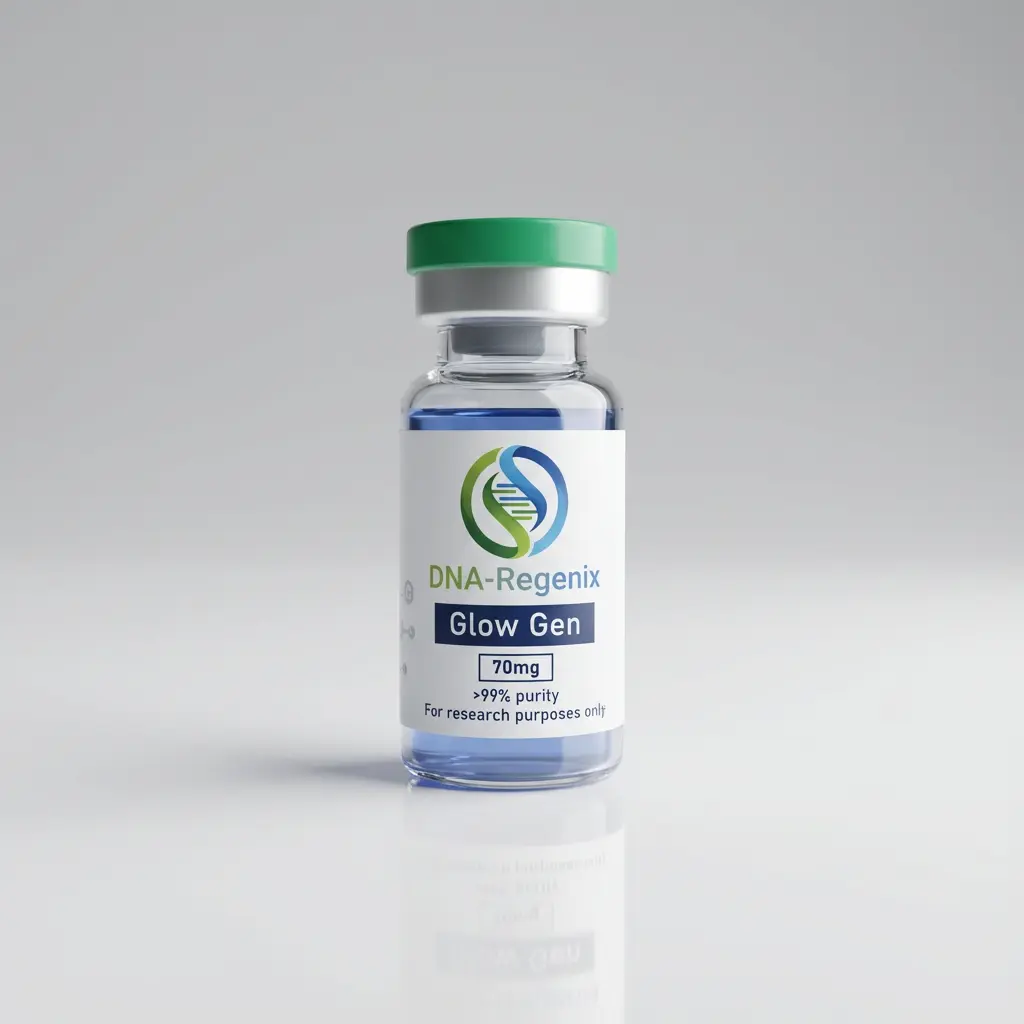
Glow Gen

$110.00

Glow Stack

Concentration: 70mg Total Active Content

Formulation:

  • GHK-Cu: 50mg (Copper Tripeptide-1)
  • BPC-157: 10mg (Pentadecapeptide)
  • TB-500: 10mg (Thymosin Beta-4 Derived Peptide)

Product Highlights:

  • Combined Research Blend: A three component blend supplied for laboratory work on copper binding peptides and actin binding sequences in a single vial.
  • Appearance: Blue and white lyophilized powder (blue hue due to the copper content).
  • Purity: >99% Verified via HPLC Analysis.
  • Solubility: Water-soluble (requires reconstitution).

LAB USE ONLY: This product is strictly for in vitro laboratory research. It is not for cosmetic use, human consumption or any use in or on the body.

SKU: FLX-GLOWGEN-70MG Category:

Description

About Glow Gen 70mg: The Glow Stack Formulation

Glow Gen is a three peptide research blend containing a total of 70mg of lyophilized active material. The formulation combines GHK-Cu, BPC-157 and TB-500 in a single research vessel, which allows a laboratory to work with all three compounds without reconstituting three separate vials. Each component keeps its own chemical identity and its own literature, and the pathways studied for each are set out below.

Component Breakdown and Research Context

1. GHK-Cu (50mg): Collagen and Fibroblast Research GHK-Cu (glycyl-L-histidyl-L-lysine copper) is a naturally occurring copper complex, first isolated from human plasma, with the INCI name copper tripeptide-1 and CAS number 89030-95-5. In laboratory models it is a subject of studies on extracellular matrix (ECM) remodelling.

  • Research Focus: Investigations into collagen I and III production, glycosaminoglycan synthesis, and the modulation of matrix metalloproteinases (MMPs) in skin fibroblast cultures (cell level) and in animal wound models (animal level).

2. BPC-157 (10mg): Angiogenesis Marker Research BPC-157 is a pentadecapeptide sequence related to a protein identified in gastric juice. Its CAS number is 137525-51-0, its formula C62H98N16O22 and its mass 1419.5 g/mol, with the sequence Gly-Glu-Pro-Pro-Pro-Gly-Lys-Pro-Ala-Asp-Asp-Ala-Gly-Leu-Val.

  • Research Focus: It has been studied for interactions with the nitric oxide system and for angiogenesis markers (the formation of new blood vessels) in rodent soft tissue models such as tendon and ligament preparations (animal level).

3. TB-500 (10mg): Cell Migration Research TB-500 is a synthetic peptide derived from thymosin beta-4 (Tbeta4). The name is used for peptides based on the actin binding region of Tbeta4 (Ac-LKKTETQ, residues 17 to 23); some suppliers apply it to full length synthetic Tbeta4. The batch certificate of analysis confirms which form a vial contains. For the acetylated heptapeptide form the identifiers are CAS 885340-08-9, C38H68N10O14 and 889.0 g/mol.

  • Research Focus: This peptide is researched for its actin sequestering properties. Work in this area concerns actin polymerisation, cytoskeletal organisation and cell migration in cell culture and animal models (cell and animal level).

Technical Data Sheet

  • Sequence: Blend of 3 distinct peptide sequences.
  • Total Content: 70mg, plus or minus 5%
  • Purity: >99% (determined by HPLC)
  • Storage (Powder): Store at minus 20 degrees Celsius, sealed and protected from light and moisture; see the batch documentation for the retest date.
  • Storage (Reconstituted): Once mixed with bacteriostatic water, hold at 4°C, protected from light, and avoid repeated freeze thaw cycles. The GHK-Cu complex is the light sensitive component; refer to the batch documentation for in-use stability rather than a fixed figure.
  • Appearance: The lyophilized cake may appear pale blue due to the copper content (GHK-Cu).

Testing and Quality Control

  • HPLC (high performance liquid chromatography): to determine the purity profile of each constituent compound.
  • MS (mass spectrometry): to verify the molecular identity of each constituent.

HPLC and mass spectrometry establish purity and identity only. Neither technique measures biological activity, so no potency conclusion is drawn from them.

For laboratory research use only. Not for human or veterinary use.

Further reading