Description
KLOW Blend Overview
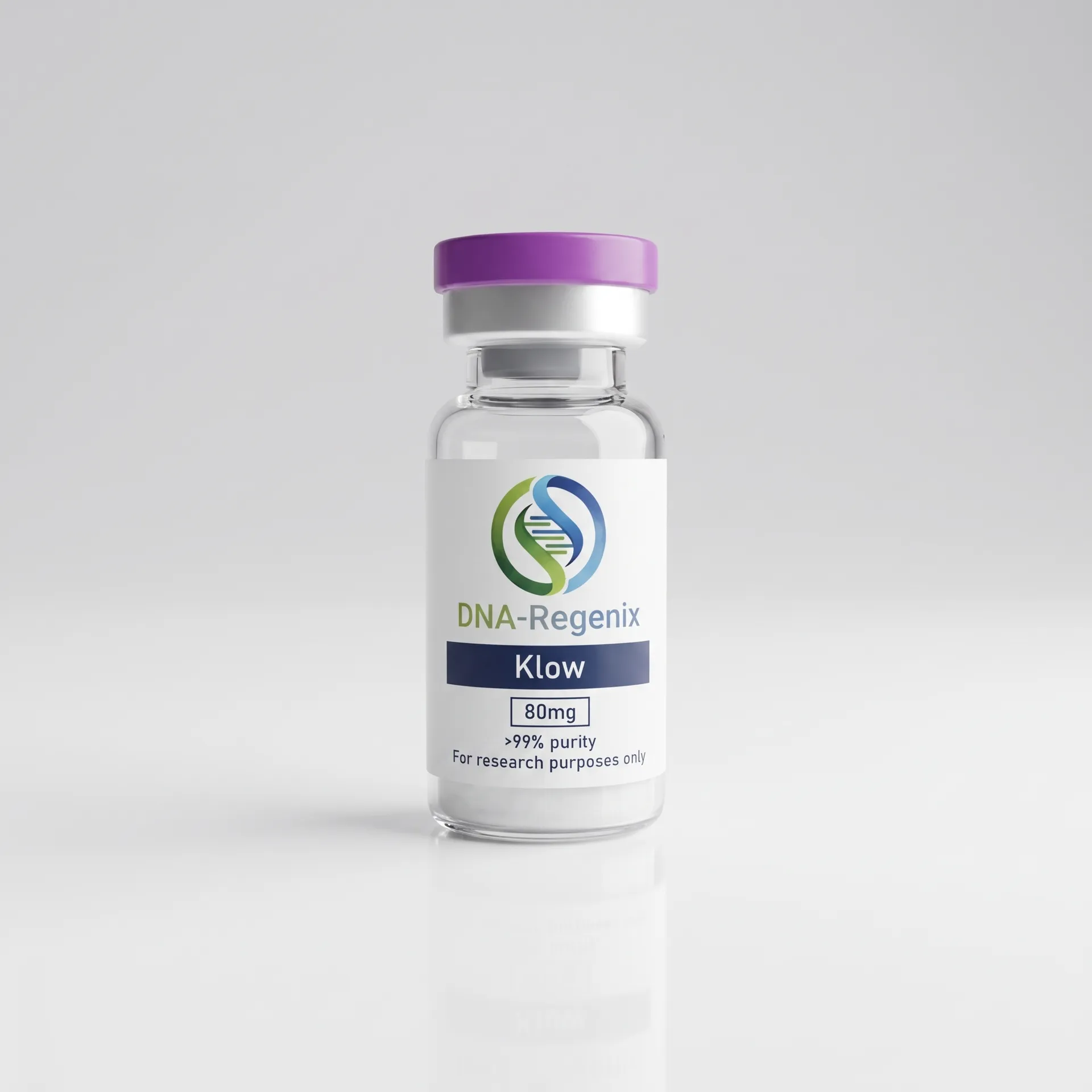
KLOW Blend 80mg is a fixed ratio research blend of four peptides presented as one lyophilized cake: GHK-Cu, BPC-157, TB-500 and KPV. KLOW is a supplier naming convention for this four component combination rather than a chemical name, so the product has no single sequence, CAS number or molecular weight of its own. Each constituent retains its own identifiers, listed below. Because the ratio is fixed, every aliquot drawn from a reconstituted vial contains all four components in the same proportion, with GHK-Cu accounting for 50 of the 80mg.
Formulation
- GHK-Cu: 50mg (copper tripeptide-1)
- BPC-157: 10mg (pentadecapeptide)
- TB-500: 10mg (thymosin beta-4 derived peptide)
- KPV: 10mg (Lys-Pro-Val tripeptide)
This split is the one published consistently by research peptide suppliers for an 80mg KLOW vial. Confirm the amounts for a given vial against the batch certificate of analysis before entering them in study records.
Technical Specifications
- Product Name: KLOW Blend 80mg (GHK-Cu / BPC-157 / TB-500 / KPV)
- Synonyms: KLOW, KLOW 80, GHK-Cu and BPC-157 and TB-500 and KPV blend
- Combined Mass: 80mg total peptide content
- Purity: ≥99.0% (determined by HPLC for each constituent compound)
- Appearance: Lyophilized cake, white to off-white with a pale blue tint contributed by the GHK-Cu copper complex; the other three components are colourless
- Solubility: Soluble in sterile water or bacteriostatic water
Constituent Identifiers
- GHK-Cu: the copper(II) complex of glycyl-L-histidyl-L-lysine, INCI name copper tripeptide-1, CAS 89030-95-5
- BPC-157: pentadecapeptide, sequence Gly-Glu-Pro-Pro-Pro-Gly-Lys-Pro-Ala-Asp-Asp-Ala-Gly-Leu-Val, CAS 137525-51-0, C62H98N16O22, 1419.5 g/mol
- TB-500: CAS 885340-08-9, C38H68N10O14, 889.0 g/mol, sequence Ac-Leu-Lys-Lys-Thr-Glu-Thr-Gln (see the terminology note below)
- KPV: Lys-Pro-Val, CAS 67727-97-3, C16H30N4O4, 342.43 g/mol
Research Context
The four component combination has not been characterised as a single entity in the published literature, so the notes below describe each constituent and the evidence level behind the work cited.
- GHK-Cu: a copper binding tripeptide originally isolated from human plasma. It has been studied in skin fibroblast culture and in animal wound models for extracellular matrix turnover, including collagen and glycosaminoglycan synthesis and matrix metalloproteinase expression (cell and animal level).
- BPC-157: a pentadecapeptide sequence related to a protein identified in gastric juice. It has been studied in rodent soft tissue models for interactions with the nitric oxide system and for angiogenesis markers (animal level).
- TB-500: studied as a G-actin binding peptide. Work in this area concerns actin polymerisation, cytoskeletal organisation and endothelial cell migration (cell and animal level).
- KPV: the C-terminal tripeptide of alpha-melanocyte-stimulating hormone (α-MSH residues 11 to 13). Dalmasso and colleagues reported in Gastroenterology in 2008 that nanomolar KPV taken up through the PepT1 transporter was associated with reduced NF-κB and MAP kinase signalling in human intestinal epithelial and T cell cultures, and with lower inflammation scores in two mouse colitis models (cell and mouse level).
A Note on TB-500 Terminology
TB-500 is a synthetic peptide derived from thymosin beta-4 (Tbeta4). The name is used for peptides based on the actin binding region of Tbeta4 (Ac-LKKTETQ, residues 17 to 23); some suppliers apply it to full length synthetic Tbeta4. The batch certificate of analysis confirms which form a vial contains. The identifiers listed above are those of the acetylated heptapeptide. Full length synthetic Tbeta4 is a different molecule: a 43 residue peptide with the formula C212H350N56O78S and a mass near 4963 g/mol.
Storage and Handling
- Lyophilized (powder): Store at minus 20 degrees Celsius, sealed and protected from light and moisture; see the batch documentation for the retest date.
- Reconstituted (solution): Hold at 4°C, protected from light, and avoid repeated freeze thaw cycles. Refer to the batch documentation for in-use stability rather than a fixed figure.
- Handling: Standard laboratory safety practice applies. Copper complexes are light sensitive, so keep vials shielded from light.
Testing and Quality Control
- HPLC (high performance liquid chromatography): to determine the purity profile of each constituent compound against the ≥99.0% specification.
- MS (mass spectrometry): to verify the molecular identity of each constituent after blending.
HPLC and mass spectrometry establish purity and identity only. Neither technique measures biological activity, so no potency conclusion is drawn from them.
For laboratory research use only. Not for human or veterinary use.
Further reading