Flux Peptides
$0.00 0

Cart

No products in the cart.

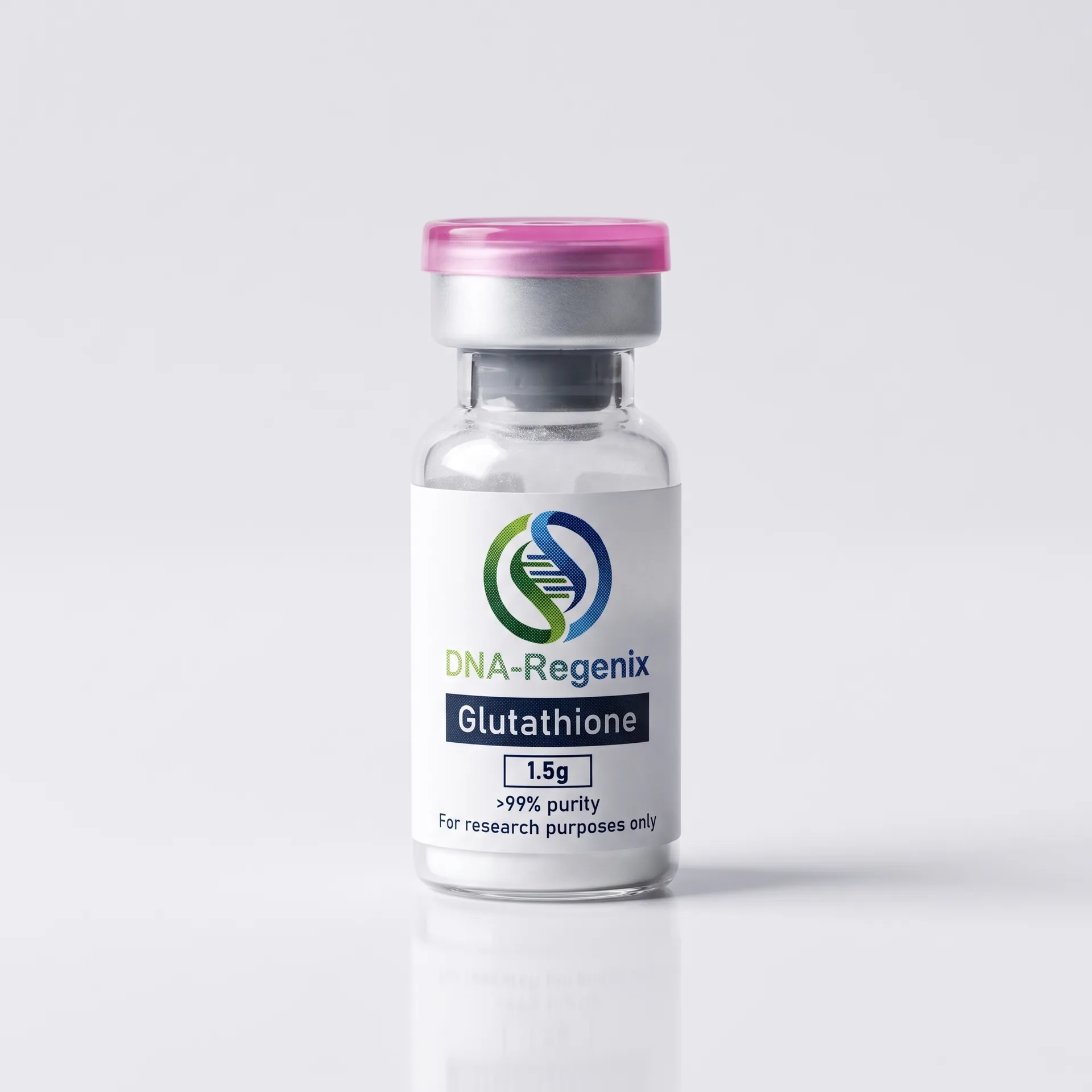
L-Glutathione

$50.00

L-Glutathione (GSH) is the endogenous tripeptide gamma-L-glutamyl-L-cysteinyl-glycine. It is formed from L-glutamic acid, L-cysteine and glycine, with the glutamate joined through its side chain carboxyl group rather than through a standard peptide bond. It is used in cell and biochemistry research as a reference compound in redox work, as a reducing agent, and as the substrate of the glutathione peroxidase and glutathione S-transferase enzyme families.

  • Purity: greater than or equal to 99.0 percent (HPLC tested)
  • Enzyme systems studied: glutathione peroxidases and glutathione S-transferases (phase II conjugation)
  • Format: Lyophilized powder for laboratory research
  • Key Research Focus: cellular redox state, oxidative stress assays and phase II conjugation chemistry
  • Storage: Store at minus 20 degrees Celsius, sealed and protected from light and moisture
Category:

Description

L-Glutathione Overview

L-Glutathione (GSH) is a tripeptide present in most mammalian cells. ChEBI defines it as a tripeptide consisting of glutamic acid attached via its side chain to the N terminus of cysteinylglycine, which is why it is written as gamma-L-glutamyl-L-cysteinyl-glycine: the bond to cysteine comes from the gamma carboxyl of the glutamate side chain rather than from its alpha carboxyl. That linkage is what makes glutathione resistant to ordinary peptidases.

Glutathione exists in a reduced form (GSH) and an oxidized disulfide form (GSSG), and the ratio between the two is a standard measurement of cellular redox state. The material offered here is the reduced form. In the laboratory it is used as a redox standard, as a thiol reducing agent, and as the substrate in assays of the enzymes described below.

Regulatory status

There is no authorized standalone glutathione drug product in Canada. Health Canada’s Drug Product Database lists glutathione and glutathione disulfide only as minor components of multi ingredient products, for example an oral multi ingredient tablet and an ophthalmic irrigating solution. Glutathione is otherwise handled in Canada as a natural health product ingredient rather than as a prescription medicine. The material offered on this page is a laboratory research chemical, is not a licensed or authorized medicine, and is not supplied for any medical purpose.

Technical Specifications

  • Compound name: L-Glutathione (reduced)
  • Synonyms: GSH, gamma-L-glutamyl-L-cysteinyl-glycine, glutathione (reduced)
  • CAS number: 70-18-8
  • Molecular formula: C10H17N3O6S
  • Molar mass: 307.33 g/mol
  • Purity: greater than or equal to 99.0 percent (determined by HPLC)
  • Appearance: White to off white lyophilized powder
  • Solubility: Soluble in water

Research Context

Established biochemistry, stated as chemistry rather than as an effect on any person or animal:

  • Thiol redox chemistry: the cysteine thiol of GSH can be oxidized to the disulfide GSSG. This couple is used as a redox buffer in vitro and as a readout of oxidative stress in cell and tissue samples.
  • Glutathione peroxidases: these selenoenzymes reduce hydrogen peroxide to water, and organic hydroperoxides to the corresponding alcohols, using GSH as the electron donor and producing GSSG. GSH is the substrate of the reaction.
  • Glutathione S-transferases: these enzymes catalyse conjugation of the GSH thiol to electrophilic compounds, the phase II conjugation step studied in xenobiotic metabolism.
  • Glutathione reductase: GSSG is reduced back to GSH by glutathione reductase using NADPH, which is the regeneration arm of the cycle described above.

Storage and Handling

  • Lyophilized powder: store at minus 20 degrees Celsius (minus 4 degrees Fahrenheit) for up to 36 months, sealed and protected from light and moisture.
  • Reconstituted solution: store at 4 degrees Celsius (39 degrees Fahrenheit), protected from light, for up to 14 to 21 days. Solutions of the reduced form oxidize to GSSG on exposure to air, so prepare working solutions close to the time of use and avoid repeated freeze and thaw cycles.
  • Handling: standard laboratory safety practice applies. This product is for laboratory research use only.

Testing and Quality Control

Every batch of L-Glutathione undergoes:

  1. HPLC (high performance liquid chromatography): purity reported as greater than or equal to 99.0 percent, and separation of the reduced form from the oxidized disulfide GSSG.
  2. MS (mass spectrometry): confirms the molecular mass expected for the tripeptide.
  3. Appearance and identity checks on the lyophilized cake.

HPLC and mass spectrometry characterize chemical purity and identity. They do not measure biological activity, and no potency testing is performed or implied.

For laboratory research use only. Not for human or veterinary use.

Further reading