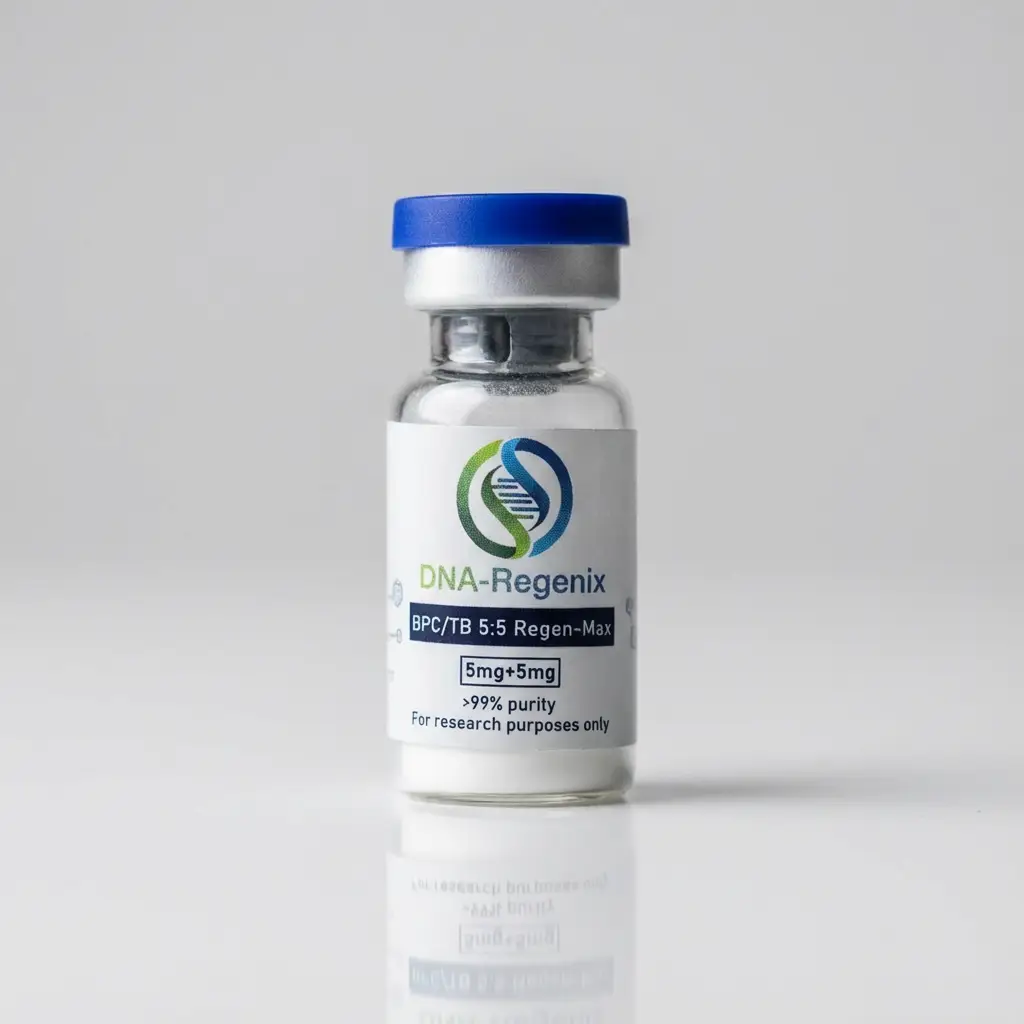
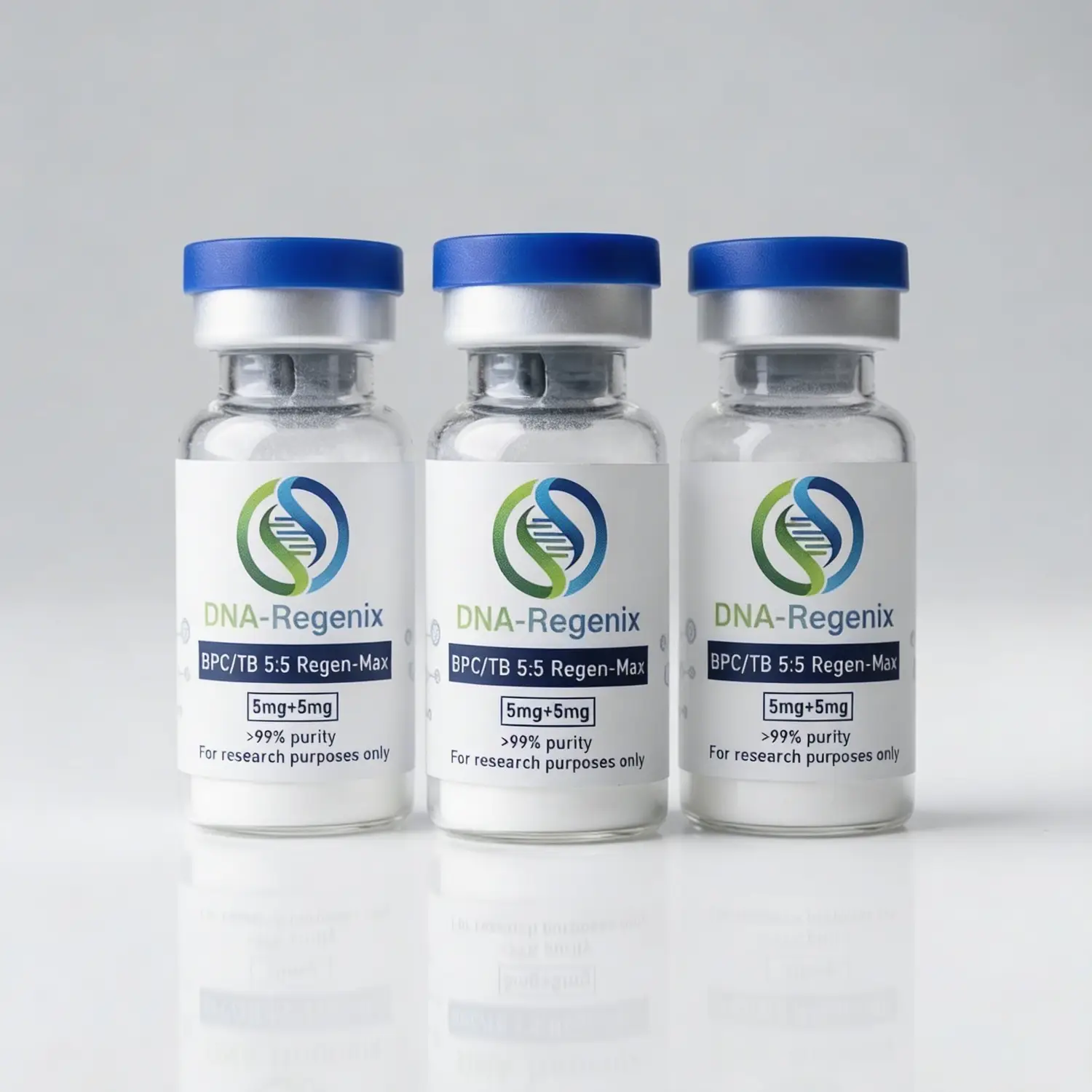
Description
BPC-157 + TB-500 Blend Overview
This blend combines BPC-157 (body protective compound 157) and TB-500 in one lyophilized vial. Each peptide has its own literature and its own chemical identity, and the two are studied in different pathways: BPC-157 in angiogenesis and growth factor receptor work in animal tissue models, TB-500 in actin binding and cell migration work in cell and animal models. The pairing itself has not been characterised as a single entity in the published literature, so no combined or additive effect is described here.
BPC-157 is a pentadecapeptide, a 15 residue sequence corresponding to a partial sequence of a protein identified in gastric juice.
TB-500 is a synthetic peptide derived from thymosin beta-4 (Tbeta4). The name is used for peptides based on the actin binding region of Tbeta4 (Ac-LKKTETQ, residues 17 to 23); some suppliers apply it to full length synthetic Tbeta4. The batch certificate of analysis confirms which form a vial contains.
Technical Specifications (Per Peptide)
- BPC-157
- Peptide Name: BPC-157 (pentadecapeptide)
- Sequence: Gly-Glu-Pro-Pro-Pro-Gly-Lys-Pro-Ala-Asp-Asp-Ala-Gly-Leu-Val
- CAS Number: 137525-51-0
- Molecular Formula: C62H98N16O22
- Molar Mass: 1419.5 g/mol
- PubChem CID: 9941957
- TB-500 (acetylated heptapeptide form)
- Peptide Name: TB-500 (thymosin beta-4 derived peptide)
- Sequence: Ac-Leu-Lys-Lys-Thr-Glu-Thr-Gln (Tbeta4 residues 17 to 23)
- CAS Number: 885340-08-9
- Molecular Formula: C38H68N10O14
- Molar Mass: 889.0 g/mol
- PubChem CID: 62707662
Purity: ≥99.0% (determined by HPLC)
Appearance: White lyophilized powder
Solubility: Soluble in sterile water or bacteriostatic water
The TB-500 figures above are those of the acetylated heptapeptide. Full length synthetic Tbeta4 is a different molecule: a 43 residue peptide with the formula C212H350N56O78S and a mass near 4963 g/mol. The two sets of figures are not interchangeable, and the batch certificate of analysis states which form a vial contains.
Research Context
The notes below describe published experiments and name the model system, so the evidence level is clear in each case.
- Angiogenesis markers (BPC-157, animal level). BPC-157 has been studied in rodent soft tissue models for interactions with the nitric oxide system and for markers of new blood vessel formation, work motivated by the poor vascularisation of tissues such as tendon and ligament.
- Growth hormone receptor expression (BPC-157, cell level). Chang and colleagues (Molecules, 2014;19(11):19066-19077) reported that BPC-157 increased growth hormone receptor expression in cultured tendon fibroblasts at both the mRNA and protein levels, and that adding growth hormone to those cultures increased cell proliferation with Janus kinase 2 activation. This is cell culture work.
- Actin binding and cell migration (TB-500, cell and animal level). TB-500 is studied as a G-actin binding peptide. By binding monomeric actin it has been investigated for effects on actin polymerisation, cytoskeletal organisation and cell migration in culture and in animal models.
- Collagen expression (blend components, cell and animal level). Type I collagen expression is a common laboratory endpoint in studies of both peptides. It is a measured marker, not a demonstrated outcome in a person.
- Anti-doping status (TB-500). The World Anti-Doping Agency Prohibited List names Thymosin-beta4 and its derivatives, giving TB-500 as the example, in section S2 (peptide hormones, growth factors, related substances and mimetics), prohibited at all times.
Storage and Handling
- Lyophilized (Powder): Store at -20°C (-4°F) for long-term stability (up to 36 months). Keep vials away from direct UV light and moisture.
- Reconstituted (Solution): Once reconstituted, store the solution at 4°C (39°F) and use within 14 days. Avoid vigorous shaking of the vial; use a gentle swirling motion instead.
- Handling: Standard laboratory safety practice applies. This product is for laboratory research use only.
Testing and Quality Control
- Dual HPLC (high performance liquid chromatography): to determine the purity profile of each of the two peptide components and their ratio in the blend.
- MS (mass spectrometry): to verify the molecular identity of both sequences.
HPLC and mass spectrometry establish purity and identity only. Neither technique measures biological activity, so no potency conclusion is drawn from them.
For laboratory research use only. Not for human or veterinary use.
Further reading