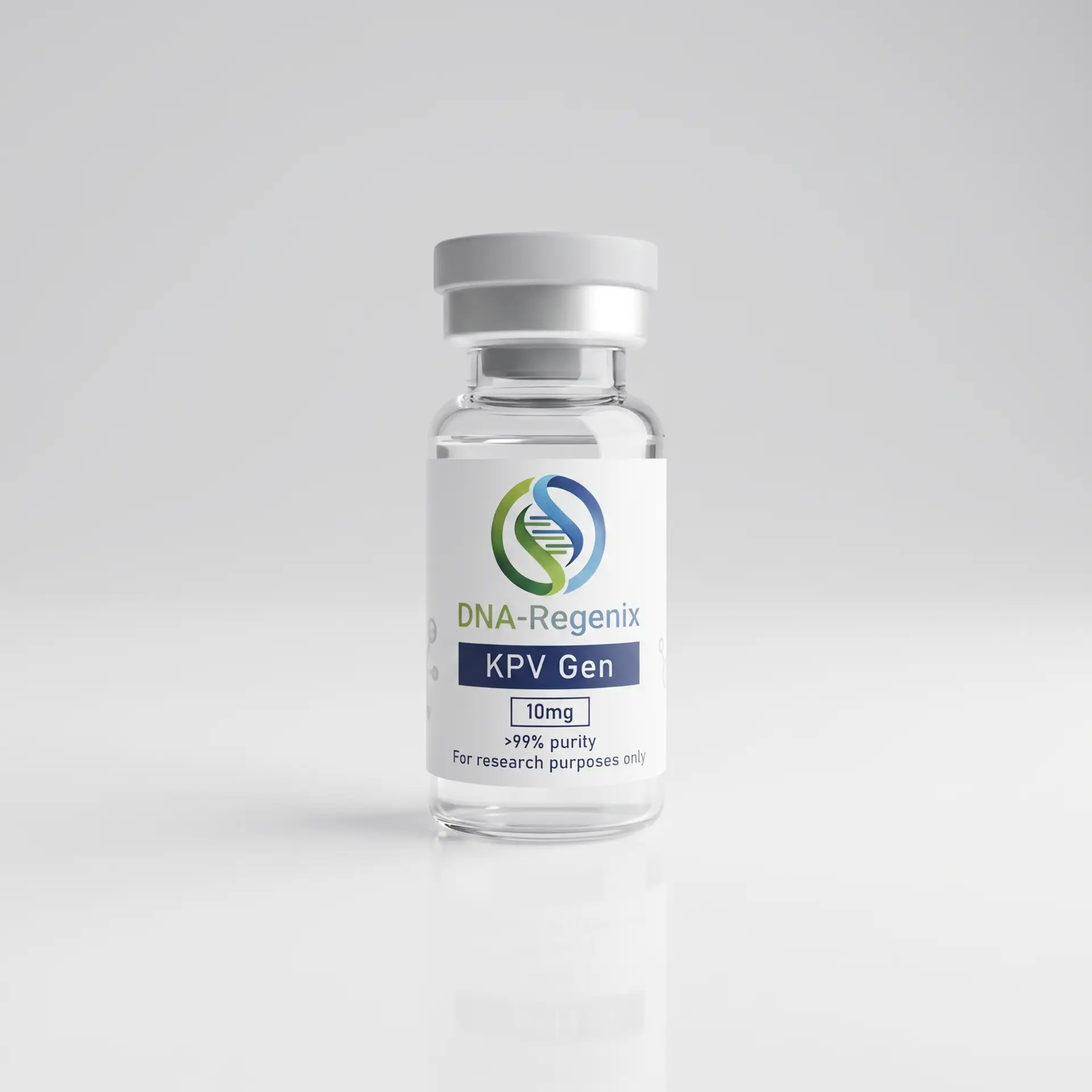
Description
KPV Overview
KPV is a tripeptide (Lys-Pro-Val) that makes up the C-terminal end of α-MSH (alpha-melanocyte-stimulating hormone), a 13 residue peptide; KPV corresponds to residues 11 to 13. It is one of the shortest peptide sequences in common research use. Published work on KPV concentrates on intracellular inflammatory signalling rather than on receptor binding at the cell surface, and the studies summarised below name the model system and the evidence level in each case.
Technical Specifications
- Peptide Name: KPV
- Synonyms: Lys-Pro-Val, lysyl-prolyl-valine, α-MSH (11-13)
- CAS Number: 67727-97-3
- Molecular Formula: C16H30N4O4
- Molar Mass: 342.43 g/mol
- PubChem CID: 125672
- Purity: ≥99.0% (determined by HPLC)
- Appearance: White to off-white lyophilized powder
- Solubility: Soluble in sterile water or bacteriostatic water
Research Context
The following summarises what has been reported in the primary literature, with the model system stated so the evidence level is clear. These are descriptions of published experiments, not statements about outcomes in a person or an animal outside those experiments.
- Intracellular signalling and transporter mediated uptake (cell and mouse level). Dalmasso and colleagues (Gastroenterology, 2008;134(1):166-178) reported that nanomolar KPV inhibited NF-κB activation and reduced pro-inflammatory cytokine output in human intestinal epithelial cell lines (Caco2-BBE and HT29-Cl.19A) and in Jurkat T cells, and that uptake was mediated by the PepT1 peptide transporter. In the same paper, KPV given in drinking water was associated with reduced inflammation in DSS and TNBS induced colitis in mice.
- Rodent colitis models and melanocortin receptor independence (mouse level). Kannengiesser and colleagues (Inflammatory Bowel Diseases, 2008;14(3):324-331) reported reduced inflammatory infiltrates in DSS colitis and in CD45RB(hi) transfer colitis in mice, and that the effect persisted in mice carrying a non-functional melanocortin-1 receptor. The authors read this as evidence of a mechanism at least partly independent of melanocortin-1 receptor signalling, which is why this listing does not describe melanocortin receptors as the target of KPV.
- In vitro antimicrobial screening (in vitro level only). Cutuli and colleagues (Journal of Leukocyte Biology, 2000;67(2):233-239) reported that α-MSH peptides including KPV inhibited colony formation by Staphylococcus aureus and reduced viability of the yeast Candida albicans in culture. This work is in vitro and does not establish an effect in a person or an animal.
Storage and Handling
- Lyophilized (Powder): Store at -20°C (-4°F) for up to 36 months. Protect from direct light.
- Reconstituted (Solution): Keep at 4°C (39°F) and use within 14 to 21 days. Avoid repeated freeze thaw cycles.
- Handling: Standard laboratory safety practice applies. This product is for laboratory research use only.
Testing and Quality Control
- HPLC (high performance liquid chromatography): to determine the purity profile against the ≥99.0% specification.
- MS (mass spectrometry): to verify the tripeptide identity (Lys-Pro-Val, 342.43 g/mol).
HPLC and mass spectrometry establish purity and identity only. Neither technique measures biological activity, so no potency conclusion is drawn from them.
For laboratory research use only. Not for human or veterinary use.
Further reading